

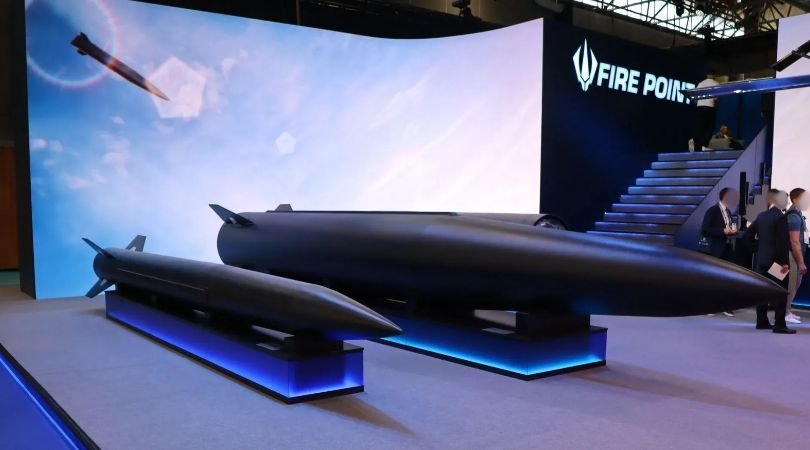
Ukraine’s Fire Point, European radar systems, and international defense cooperation are at the heart of the Freyja Interceptor program. The project could become an important part of Europe’s efforts to strengthen its air defenses, with entry into service targeted for 2027. However, several key technical challenges remain.
A Ukrainian Missile at the Heart of the Project
At the core of the Freyja Interceptor program is a surface-to-air guided missile based on Ukraine’s FP-7 development. Ukrainian defense company Fire Point plays a central role in developing the missile component.
According to Ukrainian President Volodymyr Zelenskyy, Ukraine’s part of the work has been completed. This marks an important milestone for the program, as the interceptor is one of the key elements of the future air defense system.
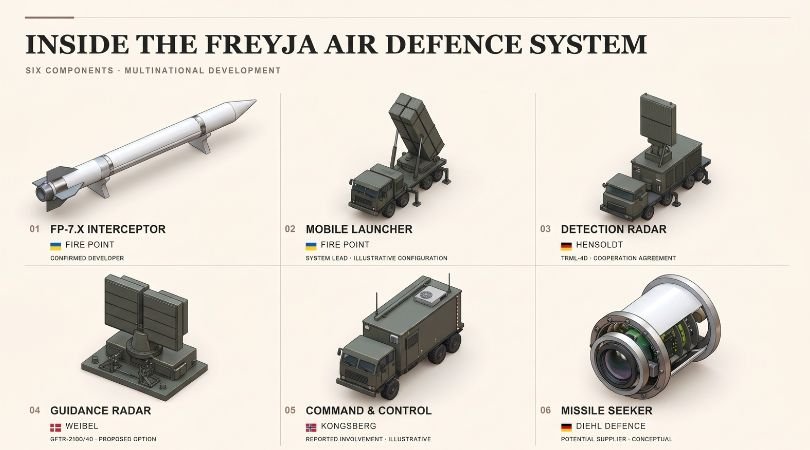
However, a completed missile does not mean the entire system is ready. To become fully operational, Freyja must integrate all its components into a unified system capable of detecting aerial threats, tracking targets, and carrying out interceptions.
The System’s “Eyes” Are Ready, but Command and Control Remain a Challenge
The Freyja program is expected to incorporate European radar systems responsible for detecting and tracking aerial targets.
The components identified so far include Germany’s TRML-4D surveillance radar and Denmark’s GFTR-2100/48 tracking radar. Their integration is expected to form an important part of Freyja’s sensor network.
However, one major component remains unfinished: the mobile command post, which is Norway’s responsibility. It is intended to coordinate the various elements and enable them to operate as a unified combat system.
The challenge is therefore no longer limited to developing individual components. It also involves ensuring compatibility, reliable data exchange, and coordinated performance under real-world operating conditions.
Germany’s Diehl Defence and the Mystery of the Missile Seeker
Another important aspect of the program is the involvement of German defense company Diehl Defence, which has reportedly been tasked with work on the missile’s seeker.
This component is critical to the interceptor’s performance. It helps the missile determine the target’s position during the final phase of flight and achieve accurate guidance.
However, the specific type of seeker being developed for Freyja, its technical characteristics, and its current development status have not been publicly disclosed.
There is also insufficient publicly available information to establish whether the technology is already used in other operational systems, represents a new development, or involves adapting an existing solution.
Diehl Defence’s involvement is therefore an important element of the international cooperation behind Freyja, but conclusions about the seeker’s design and capabilities would be premature.
European Cooperation Instead of Dependence on a Single Supplier
In addition to Ukraine, Germany, Denmark, and Norway, Sweden, the United Kingdom, France, Italy, the Netherlands, and Spain have expressed interest in the Freyja program.
This broad group of potential partners suggests that the project could become much more than the development of a new interceptor. It could help establish a European industrial and technological partnership in the field of air defense.
For Europe, this is not just a military issue but a strategic one. Domestic production capacity, control over supply chains, and the ability to scale up weapons manufacturing are becoming increasingly important amid growing global instability.
Dependence on external suppliers, particularly the United States, is an especially sensitive issue. European countries are increasingly interested in developing their own air defense capabilities rather than finding themselves in a situation where access to critical systems depends on the political decisions of their partners.
$1 Million per Interceptor Versus $3.8 Million for Patriot
Another potential advantage of Freyja is its projected cost per interception.
According to the estimates cited for the program, a single Freyja interceptor could cost approximately $1 million, compared with around $3.8 million for certain Patriot interceptor missiles.
If these figures are confirmed, the difference would be significant. For the same budget, countries could potentially procure more interceptors—a particularly important consideration during sustained aerial attacks, when air defense costs can rise rapidly.
However, comparing missile prices alone is not enough. The system’s actual effectiveness will depend on its interception range, the types of targets it can engage, its probability of success, maintenance costs, and its ability to handle multiple threats simultaneously.
Freyja’s potential cost advantage must therefore be assessed alongside its actual technical specifications and test results.
Why 2027 Could Be a Decisive Year
The year 2027 has been identified as a target for bringing Freyja into service. For Ukraine, this could mean an additional tool for protecting its airspace. For European partners, it could provide an opportunity to strengthen their own defenses through a jointly developed system.
Achieving this goal will depend on how quickly the remaining work can be completed, including development of the mobile command post, integration of the radar systems, and validation of the entire complex as a unified system.
Testing, equipment compatibility, and preparations for serial production will also be crucial.
Freyja Is More Than Just Another Missile
The Freyja Interceptor program reflects a broader trend: Europe is seeking to strengthen its defense industry and reduce its dependence on external suppliers of critical military equipment.
Ukraine’s participation is particularly significant. Its wartime experience, advances in domestic missile technology, and ability to adapt quickly to the demands of modern warfare make it an important partner in European defense cooperation.
If the program stays on schedule and its projected technical and financial advantages are confirmed, Freyja could become a promising component of Europe’s future air defense architecture.
The key question now is whether the partners can turn the components already under development into a fully operational combat system by 2027. For Ukraine, this is about additional protection for its skies. For Europe, it is a test of whether countries can work together to deliver their own advanced defense solutions.
