

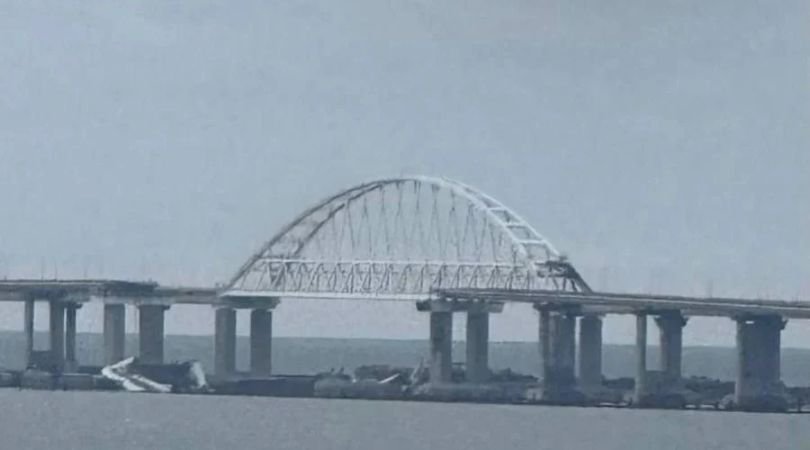
The attack on the Crimean Bridge on November 17 marked the final stage of a multi-week operation consisting of seven consecutive phases. Ukrainian President Volodymyr Zelenskyy said the operation was developed and coordinated by the Security Service of Ukraine (SBU) together with the General Staff of the Armed Forces of Ukraine.
Before reaching the main target, Ukrainian forces systematically destroyed Russian air defence systems, radars, electronic warfare (EW) equipment and other designated targets.
“Our warriors systematically destroyed air defence systems, radars, electronic warfare assets and other designated targets on the way to the final objective,” Zelenskyy said.
Ukraine’s arsenal: 11 weapons systems and developments
According to the president, the operation involved a wide range of Ukrainian weapons and technologies: Dovbush, Vendetta, Da Vinci, Sichen, MICH 2000, Ruta, Palianytsia, An-197, FP-1, FP-5 Flamingo and the R-360 Neptune missile.
Here is a brief overview of each system:
-
Dovbush — a family of Ukrainian unmanned aerial vehicles (UAVs). It includes platforms designed for reconnaissance and strike missions.
-
Vendetta — a Ukrainian unmanned system. Detailed public information about its design and the capabilities of specific variants remains limited.
-
Da Vinci — one of the Ukrainian developments named by the president among the systems used in the operation. Insufficient public technical information is available for a more precise classification.
-
Sichen — a Ukrainian strike drone. Detailed specifications and information about its variants require further confirmation.
-
MICH 2000 — a Ukrainian unmanned aerial platform mentioned among the systems involved in the operation. Public information about its design and exact specifications remains limited.
-
Ruta — a Ukrainian cruise missile-drone designed to strike targets at a distance.
-
Palianytsia — a Ukrainian jet-powered missile-drone developed to strike ground targets.
-
An-197 — a designation included by the president in the list of systems used. There is insufficient publicly available technical information to provide a confirmed description.
-
FP-1 — a Ukrainian long-range fixed-wing strike drone developed by Fire Point, designed to engage ground targets.
-
FP-5 Flamingo — a Ukrainian long-range cruise missile equipped with a powerful warhead and designed to strike high-value ground targets.
-
R-360 Neptune — a Ukrainian cruise missile originally developed for anti-ship missions. Its later variants have also been adapted to engage ground targets.
It is important to note that the president has not disclosed the precise allocation of tasks among all 11 systems. Therefore, their specific roles during the earlier stages of the operation should not be assumed without further confirmation.
Which weapons were used against the Crimean Bridge?
Volodymyr Zelenskyy separately highlighted the weapons that played a role in the final stage of the operation.
According to his statement, Palianytsia drones struck the bridge’s road section. The railway section was targeted by Neptune missiles, Ruta drones and FP-5 systems.
The president also highlighted the use of Flamingo missiles, stating that Ukrainian forces carried out a controlled strike. He added that the communication link remained operational until the final seconds.
The operation demonstrated the use of different types of Ukrainian drones and missiles as part of a coordinated, multi-stage mission.
A timeline of Ukrainian attacks on the Crimean Bridge
This was not Ukraine’s first major operation targeting the illegally constructed Russian bridge across the Kerch Strait. Over the past several years, the structure has been attacked repeatedly.
-
October 8, 2022. An explosion involving a truck carrying explosives caused several spans of the bridge’s road section to collapse. Tank cars on a freight train also caught fire.
-
July 17, 2023. Ukrainian Sea Baby naval drones attacked the bridge. One road span was completely destroyed, while another was damaged.
-
June 3, 2025. The SBU carried out an underwater operation targeting the bridge’s support structures. According to reports, 1,100 kg of explosives equivalent to TNT was used, causing serious damage to underwater components.
-
November 16, 2026. A new aerial attack caused significant damage to the road surface in at least two locations, as well as deformation of the bridge arch.
-
November 17, 2026. Powerful explosions were reported on the bridge for the second consecutive day. According to reports, an arch section of the road bridge collapsed into the water, bringing both road and rail traffic to a halt.
Scale of the damage and potential consequences for shipping
The destruction of the bridge’s road arch could have consequences not only for transport links but also for shipping through the Kerch Strait.
According to preliminary reports, the attack on the night of November 17 destroyed a steel arch measuring approximately 227 metres in length and weighing up to 6,000 tonnes. An adjacent road span was also reportedly damaged. Satellite imagery published by OSINT researchers Intelschizo and the Exilenova+ channel appears to show substantial structural damage.
The weapons potentially involved in the attack include Ukrainian missiles and drones, with the FP-5 Flamingo among the systems mentioned in preliminary reports. The exact circumstances and extent of the damage require further confirmation.
Repairing the damaged road section could take months and require complex engineering operations. Another major concern is that debris may have fallen into the Kerch-Yenikale Canal, potentially disrupting shipping between the Black Sea and the Sea of Azov.
The damage also creates additional logistical difficulties for Russian forces in occupied Crimea and along the southern front. Alternative supply routes — including ferry crossings and the land corridor through occupied Ukrainian territories — have their own capacity limitations and vulnerabilities.
If the full extent of the damage is confirmed, Russia could face a significant logistical crisis affecting several key transport routes.
The Crimean Bridge is a major transport artery used by Russia to maintain its connection with occupied Crimea. A series of Ukrainian operations has demonstrated the vulnerability of this strategic structure to different types of Ukrainian weapons.
According to the president, the latest operation was the result of several weeks of preparation and seven consecutive stages involving the SBU, the General Staff of the Armed Forces of Ukraine and Ukrainian weapons developers.
The wider impact: shipping disruption and a potential logistical crisis
The damage to the Crimean Bridge could have consequences far beyond the suspension of road and rail traffic. If debris from the collapsed arch has obstructed the Kerch-Yenikale Canal, shipping between the Black Sea and the Sea of Azov could be seriously disrupted. There is no nearby deep-water alternative route capable of easily replacing this passage.
The potential impact extends to port logistics across the region, including cargo operations connected with Rostov-on-Don, Azov, Taganrog, Yeysk, Temryuk, Mariupol and Berdiansk. Disruptions could lead to vessel queues, higher freight and insurance costs, and delays in shipments of grain, coal, metals and petroleum products.
Clearing the shipping channel would require a complex maritime engineering operation. Specialists would first need to survey the seabed and assess the condition of the bridge supports, then cut the massive steel structure into manageable sections and lift the debris from the water.
Floating cranes and construction barges could be required to remain near the bridge for an extended period. These vessels cannot necessarily leave their working positions quickly, and any new security threat could halt recovery operations and force additional inspections.
The actual duration of the disruption will depend on where the debris has settled and whether it obstructs the navigable channel. If the wreckage only partially blocks the fairway, limited shipping access could theoretically be restored relatively quickly. However, replacing the destroyed 227-metre steel arch would be a much larger undertaking, potentially requiring many months.
The consequences could therefore extend well beyond the bridge itself, affecting maritime transport, regional port operations and Russia’s supply logistics across the Sea of Azov.
Crimean Bridge: Ukraine’s seventh-stage operation by the SBU and General Staff — the weapons used in the attack
