

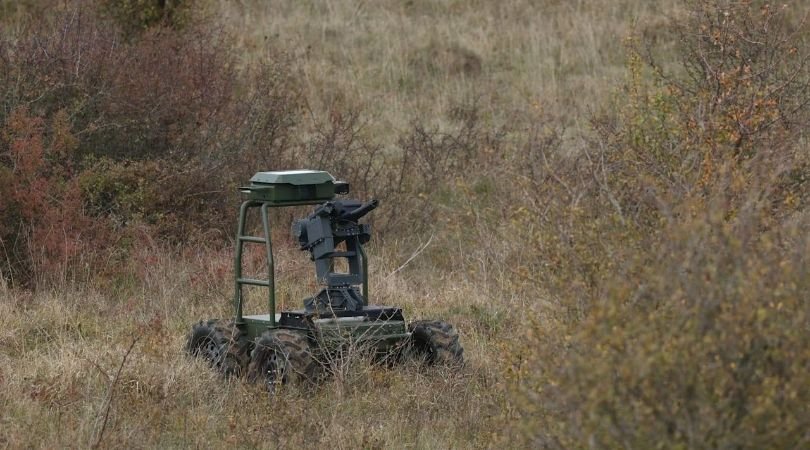
Ukraine is turning ground robots into a battlefield force: over 1,000 systems deployed every day
Ukraine’s military is rapidly expanding its use of unmanned ground vehicles (UGVs). According to the German publication Bild, the Ukrainian Armed Forces deploy more than 1,000 ground robots every day.
And these machines are no longer limited to transporting supplies or evacuating wounded soldiers. Some are now being used for direct combat missions, including attacks on Russian positions.
Ground robots are moving from support roles to combat operations
One particularly notable incident reportedly took place near Lyman in late October, when Ukrainian combat robots attacked Russian positions without accompanying infantry.
Modern robotic platforms can be equipped with various weapons, including grenade launchers, explosives, and anti-tank systems. This allows them to move beyond logistical support and take on specific combat tasks on the battlefield.
The shift is significant. Ground robots were initially developed primarily to reduce the burden on soldiers and perform dangerous support missions. Now, they are gradually becoming an independent element of modern military operations.
Their main advantage is straightforward: machines can be sent into areas where putting human lives at risk would otherwise be unavoidable.
Drones are becoming the eyes of ground robots
One of the most interesting developments is the integration of ground robots with aerial drones.
Flying drones provide additional situational awareness, effectively acting as the robots’ eyes. They can monitor the surrounding environment, identify potential threats, and transmit information to operators.
In some cases, aerial drones can even deliver ground robotic platforms beyond the front line, expanding their operational capabilities.
This creates an integrated unmanned ecosystem in which aerial and ground platforms complement each other. Rather than operating as isolated machines, they form part of a coordinated network of robotic systems.
Military expert Ulrike Franke considers Ukraine one of the global leaders in the deployment of ground combat robots. This is not simply about the number of platforms in service, but also about how quickly Ukrainian forces are introducing and adapting new technologies under real battlefield conditions.
More than 31,000 missions in a single month
Despite the growing attention surrounding combat robots, most Ukrainian unmanned ground vehicles are still primarily used for logistics and medical evacuation.
These are the areas where their deployment has already demonstrated substantial growth.
According to Ukraine’s Ministry of Defence, ground robotic systems completed 31,398 logistical and evacuation missions in October.
For comparison, the corresponding figure in January was 7,511 missions.
That represents more than a fourfold increase in just nine months.
The figures illustrate how rapidly the role of ground robotics is evolving within the Ukrainian military.
Robots are increasingly taking over tasks that previously required soldiers to enter dangerous areas of the battlefield.
Medical evacuation is particularly important. With constant surveillance from reconnaissance drones and the threat of artillery strikes, even a short movement across open terrain can expose evacuation teams to serious danger.
Robotic platforms help reduce the risks involved in these missions and limit the number of soldiers exposed to enemy fire.
The biggest challenge: communications and electronic warfare
Despite their advantages, ground robots still have a major vulnerability: their dependence on communication links.
Russian electronic warfare systems can interfere with control signals and data transmission. Losing connectivity can leave a robotic platform unable to perform its mission, particularly when operating far from its human operator.
This is why developers are increasingly focusing on autonomy.
Artificial intelligence is being integrated into robotic systems to enable machines to perform certain tasks even when communication becomes unstable or temporarily unavailable.
This does not necessarily mean fully autonomous decision-making when it comes to using weapons. Rather, the focus is on allowing platforms to navigate, continue moving, avoid obstacles, and perform predefined functions without constant human intervention.
The next stage of warfare: robotic units?
Ukraine’s experience demonstrates that ground robots are no longer merely experimental technology. They are becoming practical tools for modern warfare.
The combination of ground platforms, aerial drones, artificial intelligence, and automated control systems is creating new opportunities in logistics, reconnaissance, evacuation, and combat operations.
The most important development, however, is not the emergence of individual combat robots. It is the gradual transformation of how military operations are organized.
The more dangerous tasks machines can perform, the fewer soldiers need to be exposed to direct battlefield risks.
Ukraine is effectively becoming one of the testing grounds for the future of military ground robotics. If the current momentum continues, the next stage may go beyond individual robotic platforms toward fully integrated robotic units operating alongside human troops.
