

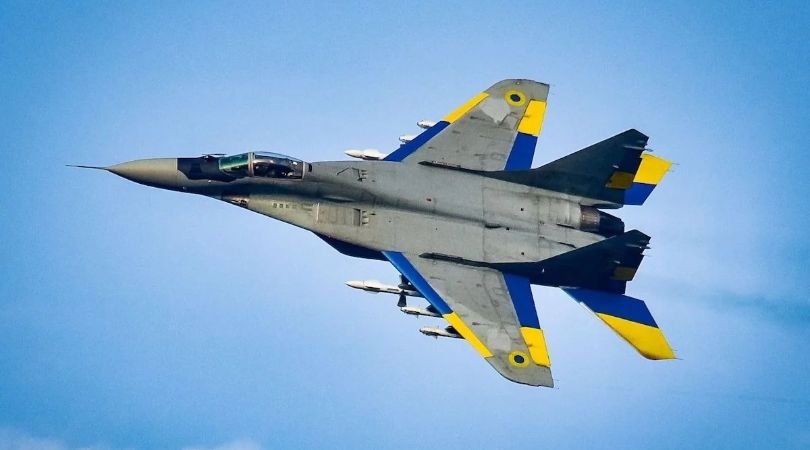
Ukraine Agrees to Share Anti-Drone Technologies with Poland in Exchange for MiG-29 Fighter Jets
Ukraine has agreed to share its anti-drone technologies with Poland in exchange for MiG-29 fighter jets. The announcement was made by Polish Deputy Defence Minister Cezary Tomczyk, who is currently visiting Kyiv, according to RMF24.
Poland and Ukraine are moving closer to an agreement that could represent a new model of military and technological cooperation between the two countries.
According to Tomczyk, Warsaw is considering transferring two MiG-29 fighter jets to Ukraine. In return, Poland is interested in gaining access to Ukrainian developments in unmanned aerial systems and anti-drone technologies. The two sides are currently finalising the details of the potential agreement.
However, cooperation is not limited to aircraft and drones. Poland and Ukraine are also discussing closer coordination within an international anti-ballistic coalition, which includes the United Kingdom, Germany, France, Italy, Spain, Sweden, Norway, Denmark and the Netherlands.
Warsaw is prepared to strengthen this initiative by contributing P-18PL radar systems. According to Tomczyk, these radars, with a reported detection range of up to 2,000 kilometres, are planned to be deployed in Poland. They would serve the interests of Poland, NATO, Ukraine and the coalition as a whole.
At the same time, one of the most challenging and important objectives remains the development of an interceptor missile capable of destroying incoming missiles. As the Polish official emphasised, achieving this will require combining the technological capabilities and resources of companies from different countries.
Essentially, this points to a broader model of cooperation in which Ukraine can contribute its battlefield experience and technological expertise, while its partners provide the industrial and technical capabilities needed to strengthen collective defence.
Poland Has Questioned the Safety of Continuing to Operate Its MiG-29s
Earlier, Poland’s Ministry of Defence stated that continuing to operate its MiG-29 fighter jets had become unsafe. The ministry also stressed that, due to evolving operational standards and the lack of spare parts, maintaining these aircraft in the Polish armed forces was no longer economically viable.
Meanwhile, analysts noted that unofficial reports describing the aircraft’s condition as “poor” appear to be supported by the available information. Ultimately, the issue concerns 14 fighter jets that are nearly 40 years old and for which Poland reportedly lacks spare parts.
A Strange Proposal
The aircraft have been declared unfit for further service, while anti-drone technologies represent one of the most relevant areas of modern warfare. At first glance, the arrangement seems absurd. But Ukraine needs spare parts.
Of course, the deal could be viewed as commercially unfavourable to Ukraine, while Poland’s position may leave an impression of greed. However, the realities of war are different. In Ukraine, almost anything can be made to fly, move or fire, even if it was never designed or considered capable of doing so. Much of this is thanks to Ukrainian engineers, repair crews and the exceptional skills of Ukrainian pilots.
Will Poland benefit from this deal? Perhaps, but possibly only in the short term. Drone warfare and counter-drone technologies are evolving so rapidly that new solutions are needed almost every day.
War is changing not only the way military operations are conducted but also our very understanding of what should be considered obsolete — and what can still be made useful.
