

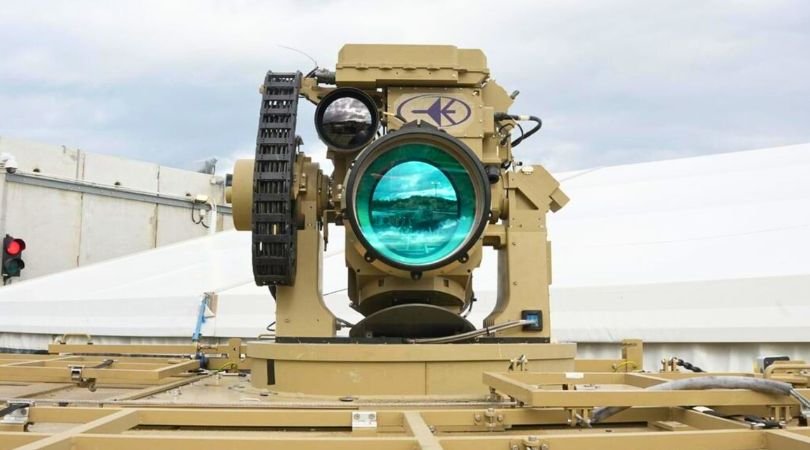
Ukrainian engineers have developed the Sunray laser system designed to destroy Russian drones.
The mobile laser weapon can be mounted on a pickup truck and silently engage aerial targets. The system’s main advantage is its cost efficiency — it is significantly cheaper than traditional air defense systems. The technology could reshape the economics of counter-drone warfare and strengthen mobile air defense capabilities.
The mass use of drones has become one of the defining features of modern warfare. Low-cost strike and reconnaissance UAVs place constant pressure on air defense systems, forcing them to use expensive missiles to destroy relatively inexpensive targets. This creates a serious economic imbalance, where the cost of interception often far exceeds the price of the drone itself.
For this reason, Ukrainian military technology developers and engineers are constantly searching for alternative ways to counter unmanned aerial vehicles.
From an efficiency standpoint, laser weapons are considered one of the most promising solutions. They can engage targets almost instantly and at a minimal cost per shot. Ukrainian engineers have now introduced their own development of this type — the Sunray laser system, designed for mobile fire units and counter-drone operations.
Sunray Laser Weapon: Design and Mobility
The Sunray system features a compact and mobile design. Its appearance resembles a large telescope equipped with multiple cameras and targeting sensors mounted on the sides of the unit.
The design allows the laser weapon to be installed on a standard pickup truck, effectively turning the vehicle into a mobile counter-drone platform.
This concept is already familiar to Ukrainian mobile air defense units and fits well with the mobile air defense strategy widely used in Ukraine. Small mobile teams can quickly change positions, protect critical infrastructure, or respond to aerial threats in different regions.
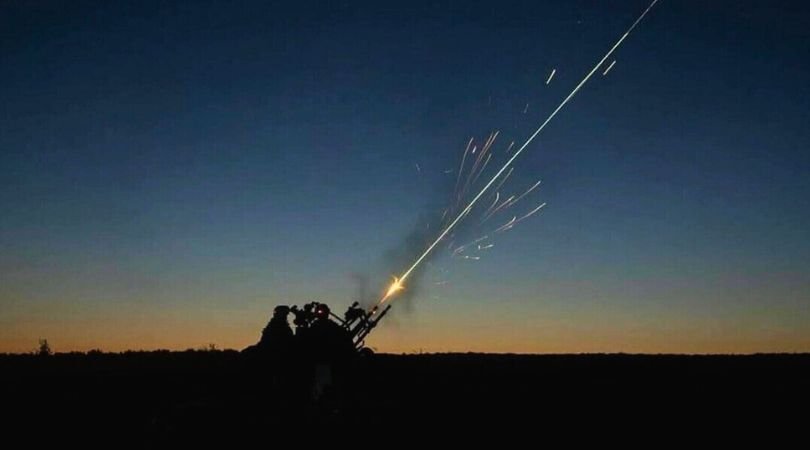
One of the key advantages of the Sunray system is its near-complete operational stealth. The laser produces no loud sound and emits no visible beam, making the system extremely difficult for the enemy to detect. As a result, it can operate covertly, destroying drones without revealing its position.
 How the Sunray Laser System Works
The engagement process begins with target detection using optical cameras and tracking systems. The cameras identify the flying object and automatically transmit its coordinates to the targeting system.
After the operator confirms the target, the laser emitter focuses a high-energy beam onto the drone’s structure.
Unlike conventional weapons, the laser acts almost instantly. The beam concentrates a large amount of energy on a small area, causing rapid heating of the drone’s structure. As a result, critical components such as the airframe, electronics, or battery become damaged.
During demonstration tests, the system tracked a drone at a distance of approximately 180 meters. After the operator gave the command to fire, the laser burned through the drone’s structure within seconds, causing it to ignite and fall to the ground.
This method of engagement is considered particularly effective against light drones, especially those with plastic structures and sensitive electronics.
Development Cost and Economic Efficiency
The development of the Sunray laser prototype took about two years. According to the developer, the project required several million dollars in investment.
As mentioned earlier, the key advantage of the system is its relatively low cost. The expected serial production price of a single unit could be several hundred thousand dollars, which is significantly cheaper than many Western laser systems.
For comparison, American and Israeli laser weapon projects are often developed under contracts worth tens or even hundreds of millions of dollars. For example, the U.S. Navy’s HELIOS naval laser system was developed under a contract worth roughly $150 million.
In this way, the Ukrainian project focuses not on expensive long-term technological programs, but on fast, relatively affordable solutions that can be rapidly scaled during wartime.
