

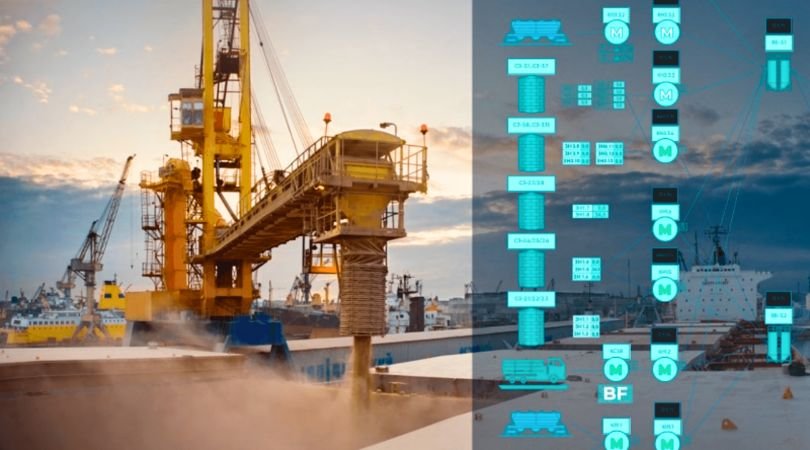
Port grain terminals are a key element of the export chain, directly impacting the profitability of agribusiness. Any delays in the reception, processing, or shipment of grain lead to losses, and in a highly competitive global market, efficiency becomes a critical factor.
Modern terminals handle hundreds of thousands of tons of grain each month, and every lost minute during transshipment or sorting can cost companies hundreds of thousands of dollars. Moreover, storage quality and logistical accuracy directly affect the terminal’s reputation and its ability to attract new clients and secure long-term contracts.
Key Challenges of Ports and Terminals Leading to Profit Loss
Every day in global logistics is a real battle: a battle against time, weather, chaos, and ultimately, a battle for profit. Creating the ideal port and winning this battle is no easy task.
Every traditional port terminal faces a whole “package of problems” that lead to demurrage, financial losses, and increased operational costs:
Blind inventory management:
Low elevator turnover and inefficient use of silos due to the lack of accurate real-time inventory data.
Capacity overloads:
Unstable schedules and the inability of terminals to handle peak loads. Warehouses and infrastructure are used inefficiently, slowing down the entire process.
Acute financial pain — vessel downtime:
Suboptimal vessel scheduling leads to demurrage and high operational expenses.
Low transparency and predictability:
Lack of control over the transshipment process and inability to track the actual economics of the chain. The system operates “blindly.”
Cargo damage and operational losses:
Unstable flows and chaotic transshipment increase losses during storage and transport.
Rising logistics costs:
Downtime and inefficient operations directly increase energy consumption and the cost per ton of handled grain.
Under these conditions, automation and the implementation of innovative solutions are no longer an “option” but a necessity. Technologies that accelerate processes, reduce human error, and increase operational transparency allow terminals to operate not only faster, but also safer, more efficiently, and more profitably. These are exactly the advantages offered by SENUMAC and SENUVOL, which have already proven themselves at leading Black Sea grain terminals.
What is SENUMAC?
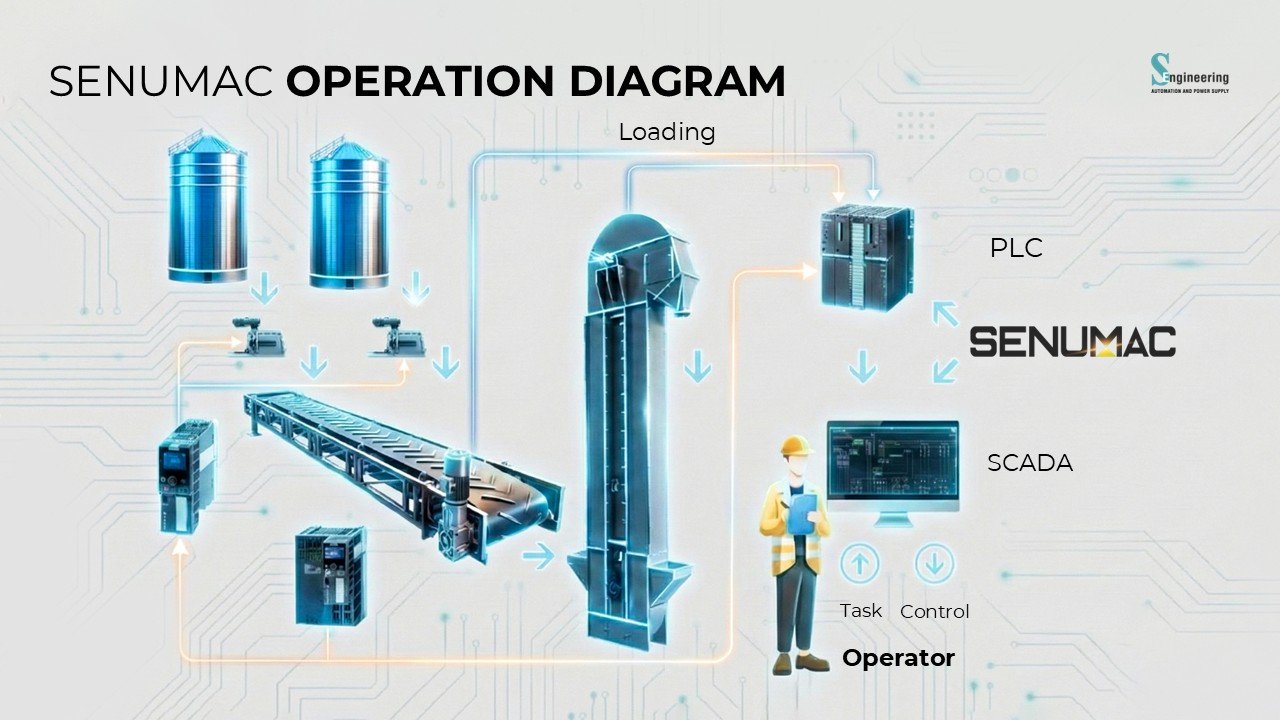
SENUMAC is a patented, modern, comprehensive control system for conveyor loading, featuring innovative technologies for optimisation and guaranteed management. The technology addresses several core challenges faced by grain elevators and transshipment terminals: it increases loading productivity, minimises human influence and reduces energy consumption.
The system minimises human involvement. It automatically brings operations to optimal mode in real time. This allows terminals to reduce vessel, railcar and truck loading times, increase overall throughput and lower operational costs.
Through precise load regulation, SENUMAC reduces energy consumption, decreases mechanical equipment wear and improves the quality of grain handling. The technology is already implemented at large grain terminals and has proven its effectiveness in real port operating conditions, where reliability, energy efficiency and predictable performance are critical.
Before developing our system and starting its implementation, our specialists thoroughly studied all the problems of port infrastructure that terminal owners face. When implementing pilot projects at the largest port terminals in Ukraine, we strictly structured them and proposed a system that solves virtually all internal and operational issues.
Why is it Necessary SENUMAC, SENUVOL and Digital Twin?
SENUMAC is a highly efficient automated conveyor line control system designed to optimise the process of shipping and transshipment of grain and other bulk cargoes at elevators and port terminals.
SENUVOL is an innovative technological system for high-precision measurement of the level, profile and volume of bulk cargo in containers in real time, allowing effective control of storage and accounting volumes of materials such as grain, which is a key element in optimising logistics and production processes.
DIGITAL TWIN is a virtual copy of the terminal that works with Senumac and Senuvol data in real time. It simulates operational scenarios (ETA, peaks, breakdowns), identifying risks and opportunities in advance, which is critical for business planning.
How the Three Systems Work Together
SENUVOL provides continuous monitoring of silo levels, profiles, and available capacity, delivering accurate real-time inventory data.
SENUMAC ensures optimal throughput of vessel loading and conveyor systems, guaranteeing efficient and predictable grain handling.
Digital Twin simulates operational scenarios, identifying potential risks and opportunities in advance, enabling informed management decisions.
Together, these technologies transmit structured data to SAP ERP (EWM, TM, IBP), integrating terminal operations with corporate planning. This integration bridges the gap between the actual state of equipment, inventory, and strategic business decisions.
Moreover, SENUMAC and SENUVOL can be deployed as an integrated solution for full terminal control or as standalone systems to address specific operational tasks.
The Role of SENUMAC in Energy Consumption
Modern ports and grain terminals operate under constant pressure: seasonal export peaks, unpredictable vessel arrivals, limited berthing windows, rising electricity tariffs, and infrastructure wear and tear. Traditional planning tools often lack real-time control and operational flexibility, leading to warehouse congestion, low line utilization, and frequent manual equipment switching.
All these factors create a chain of losses:
unstable schedules → equipment downtime → excessive energy consumption → vessel demurrage → direct financial losses.
Demurrage is not the root cause—it is the final and most costly symptom of a broader spectrum of operational problems that directly affect margins and business predictability.
SENUMAC breaks this chain of losses through comprehensive automated control of conveyor loading and line operation logic.
The system provides:
- Real-time synchronization of equipment operations;
- Optimized conveyor loading without overloads or “empty runs”;
- Elimination of manual switching and planning errors;
- Forecasting and prevention of downtime;
- Stabilization of loading speed regardless of human factors.
From an energy efficiency perspective, this delivers several key benefits:
- Reduction of peak loads — equipment operates in optimal modes without abrupt starts or overloads;
- Elimination of idle cycles — conveyors and auxiliary systems do not run without productive load;
- Shorter vessel loading time — fewer operational hours mean lower total energy consumption;
- Reduced infrastructure wear — fewer emergency stops and energy-intensive restarts.
As a result, SENUMAC transforms energy from an uncontrolled cost factor into a managed operational parameter.
This is not just about reducing demurrage—it is about increasing overall terminal productivity, improving schedule predictability, and delivering systemic electricity savings that directly enhance operating margins.
For ports and grain hubs operating in volatile markets, SENUMAC becomes not merely an automation tool, but a strategic solution for sustainable and efficient operations.
Unique Solution
The developer company, S-Engineering, a leader in automation and EPC contracting, offers a comprehensive solution to the global operational challenges of modern ports — a Real-Time Digital Twin built on SENUMAC and SENUVOL technologies.
This next-generation system connects key terminal scenarios in real time, bridges the gap between planning and actual operations, and reduces up to 30% of systemic inefficiencies, returning millions of dollars that are otherwise lost each year due to operational friction.
The combined solution includes:
- SENUVOL — high-precision, real-time inventory monitoring inside silos;
- SENUMAC — intelligent optimisation of vessel loading and conveyor line control;
- Port Digital Twin — a dynamic digital model of all key operational flows.
Together, they create a unified digital management environment for the terminal.
This approach ensures a continuous stream of reliable operational data — from actual grain volumes in each silo to vessel loading speeds and conveyor line energy consumption. The system does not merely display information; it synchronizes processes, predicts bottlenecks, and automatically adjusts operational scenarios, elevating terminal efficiency and transparency to a new level.
Implemented SENUMAC Projects
The SENUMAC technology is already being deployed at key grain terminals in the Black Sea, demonstrating measurable improvements in productivity, energy efficiency, and operational control.
Risoil Marine Grain Terminal (Chornomorsk, Ukraine)
S-Engineering is implementing SENUMAC, including assembly, software development, and commissioning. The system is designed to optimize grain loading, increase terminal productivity, reduce energy consumption by up to ~20%, and shorten vessel loading times. The solution is designed to run multiple systems in parallel to handle different vessels simultaneously.
COFCO International Terminal (Mykolaiv, Ukraine)
At the COFCO (DSSC) terminal, SENUMAC has been integrated into existing automation systems. S-Engineering also delivered power supply and process control solutions. As a result, the terminal achieved approximately 1.5× its design capacity in actual grain throughput.
Posco International Grain Terminal (Mykolaiv, Ukraine)
In cooperation with Orexim, the SENUMAC implementation included the full project cycle from design to commissioning. This increased productivity by more than 10%, reduced specific energy consumption, and automated grain mixing and loading processes.
Bunge Limited — Greentour-Ex Terminal (Mykolaiv, Ukraine)
A large-scale automation and electrification project was carried out at the Bunge terminal. SENUMAC became part of a comprehensive modernization of the production and transshipment complex, improving overall operational efficiency.
Novotech Terminal (Ukraine)
At the Novotech terminal, SENUMAC is used to increase operational control and transparency of grain handling processes. Implementation focuses on optimizing loading, reducing operational losses, and improving overall terminal efficiency through automation of key operations.
Terminal Borivazh (Pivdennyi Port, Ukraine) — in progress
As part of ongoing modernization projects, SENUMAC is considered a key solution to increasing terminal efficiency. Expected benefits include approximately 23% lower energy costs and increased terminal throughput.
Overall, SENUMAC deployments already cover terminals with a combined design capacity of around 12 million tons per year, confirming the scalability and effectiveness of the technology in real-world port logistics conditions.
About the Developer of SENUMAC and SENUVOL
The development of SENUMAC, SENUVOL, and Digital Twin is led by the team at S-Engineering, creating solutions that enable ports and terminals to reach a new level of productivity, energy efficiency, and data-driven management. Their technologies have already been implemented at leading grain terminals in Ukraine, demonstrating tangible economic benefits and enhancing the competitiveness of operators in the international market.
S-Engineering is an international engineering company specializing in comprehensive automation of industrial and port processes. The company provides a full project cycle: from design and software development to equipment manufacturing and on-site commissioning. S-Engineering combines engineering expertise, modern technologies, and years of experience delivering large-scale projects in the port and grain industries.
Business Impact
Integration with SAP ERP connects operational execution with financial and managerial control layers, providing:
- Full alignment between planning and actual operations;
- Reduced demurrage and downtime;
- Lower energy consumption through optimized operating modes;
- Reduced infrastructure wear and fewer emergency stops;
- Enhanced transparency for management and shareholders;
- Scalability as throughput volumes increase.
Instead of reactive management, the port gains predictive control.
Instead of hidden losses — measurable performance.
Instead of chaotic peak loads — stable and predictable productivity.
This approach transforms the port from a collection of fragmented processes into a synchronized, energy-efficient, and scalable node within the global supply chain.
In a context of global competition and increasing efficiency pressure, the winners are not the terminals that merely expand capacity, but those that can manage data, processes, and energy in real time. Solutions based on SENUMAC, SENUVOL, and Digital Twin create a new operational model for ports — where every action is calculated, every resource optimized, and every decision based on precise data. This is not just a technological upgrade; it is a transition to a new level of management that directly determines competitiveness and business resilience in the global market.
