

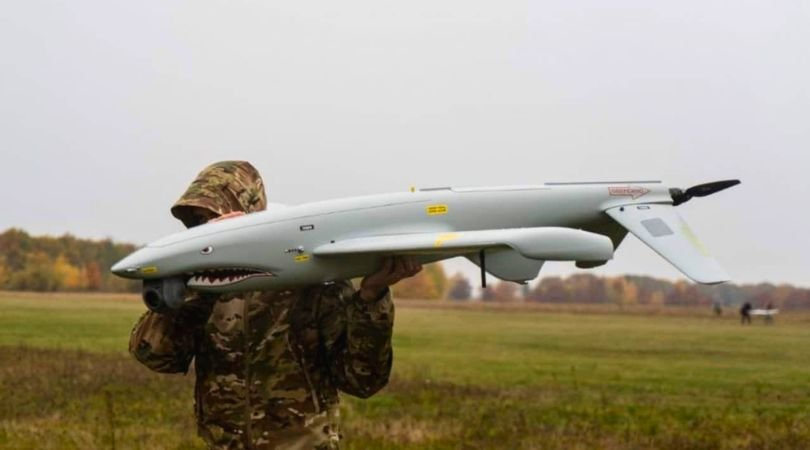
Ukraine’s production of jet-powered drones is increasingly constrained not by design or demand, but by a shortage of engines. According to Reuters, limited availability of small turbojet engines has become the key bottleneck in scaling up these systems.
Ukraine has been активно deploying jet drones for deep strikes inside Russian territory. Unlike propeller-driven UAVs, these drones can reach speeds of up to 900 km/h, making them far harder to intercept while remaining significantly cheaper than cruise missiles. This creates a highly effective middle ground between low-cost drones and expensive precision weapons.
These systems are also part of a growing technological competition. On the Russian side, comparable platforms include jet-powered drones such as the Geran-5, reportedly capable of flying up to 1,000 km and carrying warheads of up to 90 kg.
However, Ukraine faces structural supply constraints. Only a handful of manufacturers in Europe produce the required mini turbojet engines, and most are already operating at full capacity. Expanding production is neither quick nor simple, requiring time, investment, and regulatory approvals.
Geopolitics further complicates the picture. Russia is believed to partially source components through China and other indirect channels, while Ukraine relies on a limited pool of transparent European suppliers subject to export controls.
Domestic development efforts are underway, with Ukrainian engineers working on local engine solutions and alternative designs. But for now, these projects have yet to reach the scale needed to meet battlefield demand.
As a result, Ukraine finds itself in a paradox: it has successfully advanced its long-range strike capabilities, but future growth will depend less on innovation and more on industrial capacity and access to critical components.
The shortage of engines is rapidly emerging as one of the defining constraints in the evolution of long-range drone warfare.
