

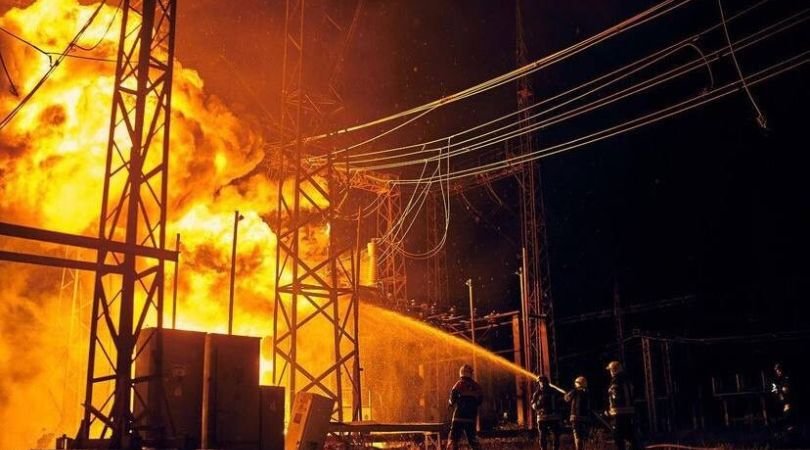
On the night of 7 February, Russian occupiers launched a massive attack on Ukraine’s power grid. Russia changed tactics again and targeted the high-voltage network in order to damage connections between western and eastern Ukraine, as well as to disrupt imports and thermal power generation outside populated areas.
“The situation on the left bank is bad – consumption is high, but generation is low. That is why the Russians are now trying to cut off power to industrial facilities on the left bank of the Dnipro,” experts say.
On 7 February, energy facilities in eight regions were hit by Russian missiles and drones. Russia attacked substations and 750 kV and 330 kV power lines, which form the backbone of Ukraine’s power grid. The enemy also struck power generation facilities: the Burshtyn and Dobrotvir thermal power plants.
As a result of missile strikes on key high-voltage substations that supplied power to nuclear power units, all nuclear power plants in the controlled territory were forced to reduce their output. This led to a significant increase in the power deficit in the energy system.
President Volodymyr Zelenskyy emphasised that during the attack on 7 February, Russia targeted facilities that are crucial to the safety of Ukrainian nuclear power plants. One power unit even shut down automatically due to the shelling. Such strikes pose a threat not only to Ukraine but to the whole of Europe. During the shelling, the enemy used more than 400 drones and nearly 40 missiles of various types.
In total, Russia carried out massive strikes on Ukrainian territory last week, using more than 2,000 strike drones, 1,200 guided aerial bombs and 116 missiles of various types.
